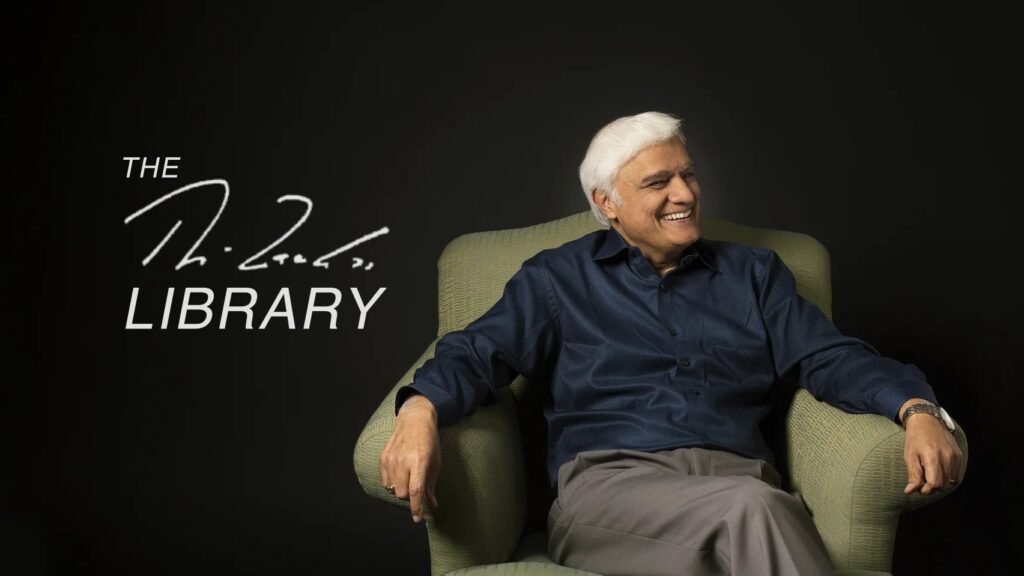
More than 160 recordings of Ravi Zacharias’ talks and lectures are online again, five years after the deceased apologist’s ministry confirmed allegations of his grooming and sexual abuse and took everything down.
A new website, The Ravi Zacharias Library, is selling audio recordings for $3.50, $7 and $10 each.
A family-run Facebook account announced the launch of the library to its nearly 9,000 followers on January 4. “Ravi was uniquely gifted and used by the Lord to share the beauty of the Gospel,” the post said. “We’re thankful to be able to make his content available, once again.”
Zacharias’ son Nathan published an edited version of the statement on his website on Jan. 5.
“Ultimately, this is the Lord’s truth, story, and work,” he wrote. “Our hope is that … God may use it as He wills, and those who seek it may find it.”
Former staff and leaders who pushed for accountability at Ravi Zacharias International Ministries (RZIM), told The Roys Report (TRR) they were surprised, shocked, angry and heartbroken over the launch of the library.
“I stand in support of the women who were abused by Zacharias,” Amy Orr-Ewing, former president of the Oxford Centre for Christian Apologetics, said in an email. “I cannot see any reason to publicise Zacharias’ messages.”
Carson Weitnauer, who worked in RZIM’s Atlanta office until he resigned in protest in 2021, said after he got over the surprise, he was overcome with sadness.
“Ravi would talk about how he’d leave no stone unturned in the quest for truth,” Weitnauer told TRR. “But then this library is burying the truth in the quest for profit.”
Talks and lectures removed from the Internet
Until this week, the disgraced apologist’s work appeared to be headed for oblivion. While evangelicals disagree widely about who should be “cancelled” — and what merits cancellation — Zacharias’ work was effectively disappearing.
Seven months after he died in 2020, Christian radio networks across the United States stopped rebroadcasting Zacharias’ popular program Let My People Think. HarperCollins, the largest publisher of Christian books in the U.S., pulled his titles, including several bestsellers. HarperCollins also halted plans for a final posthumous work.
Another apologist, Lee Strobel, stopped publication of a book that featured a 19-page interview with Zacharias. He released a revised edition “updated and expanded,” with the interview excised.
RZIM itself removed Zacharias’ talks, lectures and Q&As from the internet, expressing regret at the hurt he caused multiple women over the course of many years.
The apologetics ministry’s website remains dormant today. RZIM appears inactive, though CEO Peter Sorensen has continued to file paperwork with the state of Georgia to keep RZIM open.
A few old videos of Zacharias’ teaching remain on YouTube. They are interspersed with others titled “What Ravi Zacharias Did,” “Ravi Zacharias: A Tragic Missed Repentance” and “Is Ravi Zacharias in Heaven? Thoughts.”
Several stray audio recordings are available on SoundCloud, including one lecture on “desacralization” that has been streamed more than 18,000 times. And there are still many used books for sale online.
But someone who doesn’t accept the evidence of Zacharias’ abuse — or doesn’t think the abuse diminishes the value of his teaching — would be hard pressed to find much to watch or listen to.
‘Legacy will be restored’
Nathan Zacharias has been fighting to change that. Since 2021, the youngest of Zacharias’ three children and the only son has pushed and pleaded with RZIM to give the copyrights over to the family.
“I believe that one day my Dad’s actual legacy will be restored,” Nathan Zacharias wrote at the time.
Zacharias rejects the investigations of his father that found evidence of sexual abuse, including the investigation paid for and accepted by RZIM. He has accused those involved of being dishonest, biased, unethical and cruel. His website is called “Defending Ravi.”
Part of the defense is attacking the evidence, part attacking the procedures and part attempting to gain control of intellectual property.
In 2023, the board considered licensing Zacharias’ likeness, image and audio to the family for five years. The offer came with some conditions.
“It would be important that we agree not to disparage one another, publicly or otherwise,” the board said in a letter to Zacharias’ younger daughter, Naomi Zacharias Zumbach. “Our partnership in this project with you would be difficult if such disparagement occurs.”

The board also asked for a commitment to “pursue a biblical reconciliation” that might repair the relationship between the board and the Zacharias family.
Zumbach, who now runs a humanitarian grant-making organization, rejected the terms. In a letter later shared on the Defending Ravi site, she accused the RZIM board of engineering the terms so that the family would have to reject them.
“The mission or the organization … once included ‘the preaching and teaching of Ravi Zacharias,’” Zumbach wrote. “I do hope you will honor that part of the mission and make his resources available once again.”
Zumbach said she was speaking for her brother and mother, Margie Zacharias. The eldest Zacharias daughter, former RZIM CEO Sarah Phillips, was not involved.
Family controls intellectual property
It is unclear how negotiations over the intellectual property and copyright have developed in the last two years. The Ravi Zacharias Library, Nathan Zacharias, RZIM, and Peter Sorensen did not reply to emails with questions about the legal arrangements.
According to the “about page” on the new website, the library is run by family members and not associated with RZIM.
“We have no affiliation with RZIM today, nor knowledge of their current activities,” this site says. “Per RZIM’s request, we removed any mention of RZIM operations from these recordings.”
The website does not indicate whether more audio or other materials will be made available on the site in the future, or if this is a complete collection.
In its first few days online, the Ravi Zacharias Library also experimented with other efforts to restore Zacharias’ reputation. A biography, later pulled down, did not mention any controversies or scandals, presenting the late apologist as a modern saint.
“His gentleness, humility and calling were evident not just his preaching, but in his heart for those in need,” the bio said. “People would marvel at the evident mark of the Holy Spirit upon him.”
Former RZIM board member Stacy Kassulke called the bio “a doozy.”
Kassulke said the whole project seems like an effort to evade reckoning with the real harm that Zacharias did.
“This release is heartbreaking, but not surprising,” she said. “If we’re still at the first stage of even simply acknowledging the events, there’s a long way to go.”
Experts say many Christian leaders have attempted a comeback after scandal, but the posthumous restoration of a ruined reputation is unheard of.
Christian publishing veteran Jeff Crosby, president of the Evangelical Christian Publishers Association, said he couldn’t think of any examples from his 42 years in the industry.
Historian Suzanna Krivulskaya, author of Disgraced: How Sex Scandals Transformed American Protestantism, said she didn’t know of any from history.
“Most got away with things while still alive,” Krivulskaya told TRR. But considering how often abusive behavior has been excused with platitudes about the biblical King David and how God uses broken people, she said, “I wouldn’t be surprised.”
Report by Daniel Silliman
About The Author




Leave a Reply